An AdiOS analysis, synthesizing public reporting. July 2026.
For three decades, the global economy ran on a single algorithm: produce where it is cheapest and sell wherever demand exists. That algorithm built the modern world. It lifted billions out of poverty, cut the cost of goods, and wove nations into dense webs of commerce that were widely assumed to guarantee peace. But the same algorithm quietly concentrated the world's most strategic capabilities into a handful of geographic monopolies. Refining capacity for the minerals that power every electric motor gathered in China. The tools to manufacture advanced semiconductors gathered in the United States and its allies. The plumbing of international finance stayed anchored in New York. What efficiency built, states have now learned to weaponize.
The global economy has crossed a structural threshold. It has moved from an Efficiency Economy, in which interdependence was treated as a stabilizing force, to a Leverage Economy, in which dependencies are deliberately cultivated, mapped, and deployed as instruments of state power. The evidence through mid-2026 is no longer anecdotal. It is systematic, legislated, and institutionalized on both sides of the Pacific.12
The key findings run end to end. China has converted its two-decade investment in mineral processing into an active coercive instrument, and has built a licensing regime with extraterritorial reach.34 The West has responded with the largest peacetime industrial mobilization in decades, committing tens of billions of dollars of public capital and erecting new coalitions to rebuild trusted supply chains.56 The semiconductor conflict has settled into a managed bifurcation with a Washington-controlled licensing valve over every advanced chip that crosses into China.7 The financial system is fragmenting more slowly but just as surely: foreign central banks now hold more gold than US Treasuries for the first time since 1996.8 And the bill has arrived. Fragmentation already costs the world 213 to 307 billion dollars per year.9
For business leaders, the implication is stark. Resilience is no longer a slide in the risk deck. It is a permanent line item on the income statement, a board-level governance mandate, and, for those who move early, a source of state-subsidized competitive advantage.
From Efficiency to Leverage
The globalization era that ran from roughly 1990 to 2018 was governed by commercial logic. Comparative advantage determined where things were made. Just-in-time inventory and single-source procurement squeezed out every dollar of slack. Policymakers treated the resulting interdependence as a self-enforcing peace mechanism.
The flaw in this system was invisible precisely because it was profitable. Relentless cost optimization does not distribute capabilities evenly across the globe. It concentrates them. By the mid-2010s, the efficient global economy had quietly become a network of single points of failure.
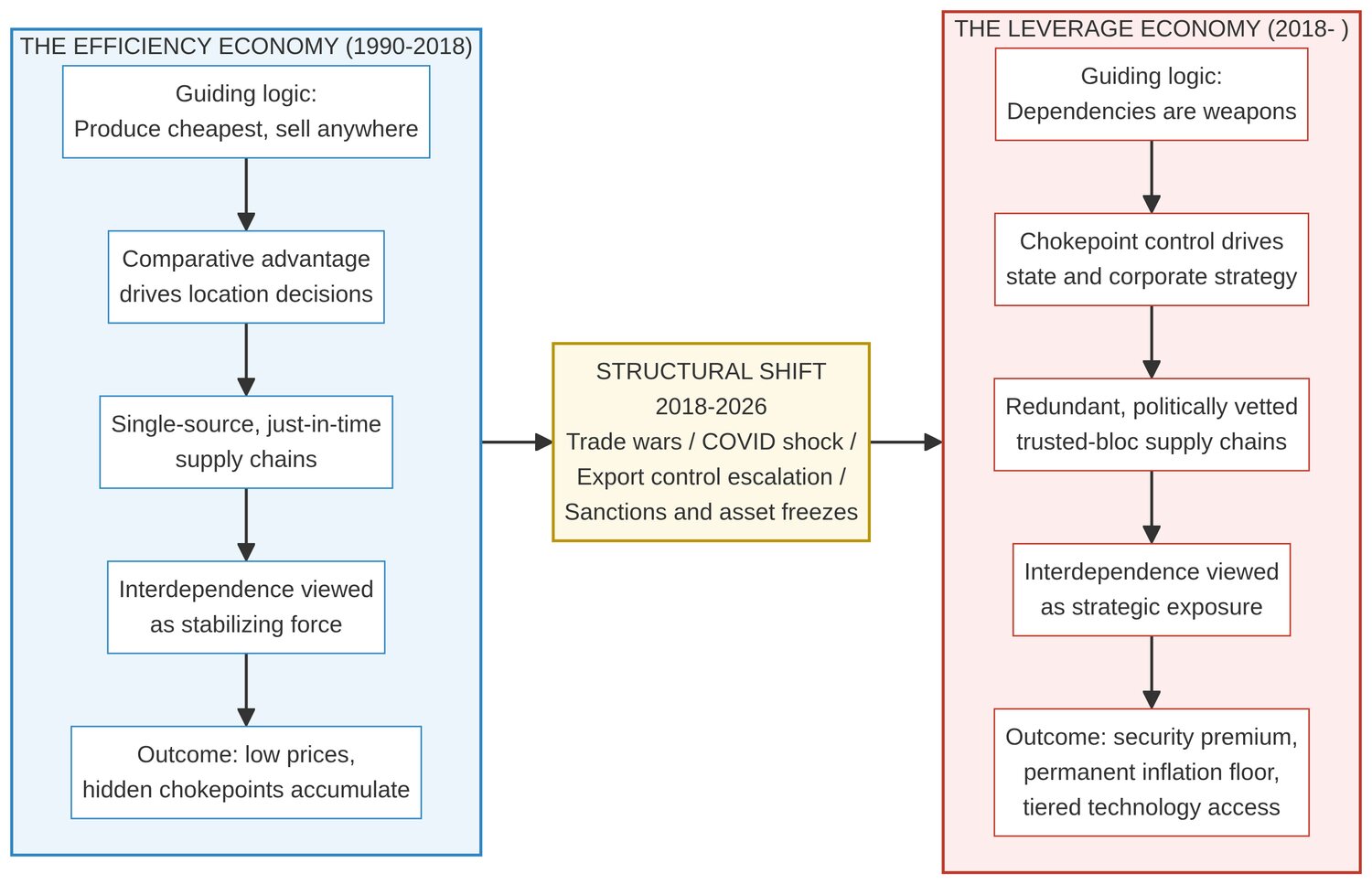
In 2019, political scientists Henry Farrell and Abraham Newman gave this vulnerability a name. Their theory of weaponized interdependence showed that states controlling the hub nodes of global networks can exploit them two ways: a "panopticon effect" to observe the flows passing through networks they control, and a "chokepoint effect" to cut adversaries off from those flows entirely.1 What was an academic framework in 2019 is operating doctrine in 2026. All dependencies are now being weaponized, spanning minerals, semiconductors, currencies, and logistics corridors.2
The escalation climbed rung by rung over sixteen years. China's 2010 halt of rare earth shipments to Japan was the first modern demonstration that a commercial monopoly could serve as a diplomatic weapon. The United States answered with financial sanctions, the Huawei Entity List, and the October 2022 advanced chip controls. China codified mirror-image legal tools through 2020 and 2021, then gallium and germanium restrictions in 2023.10
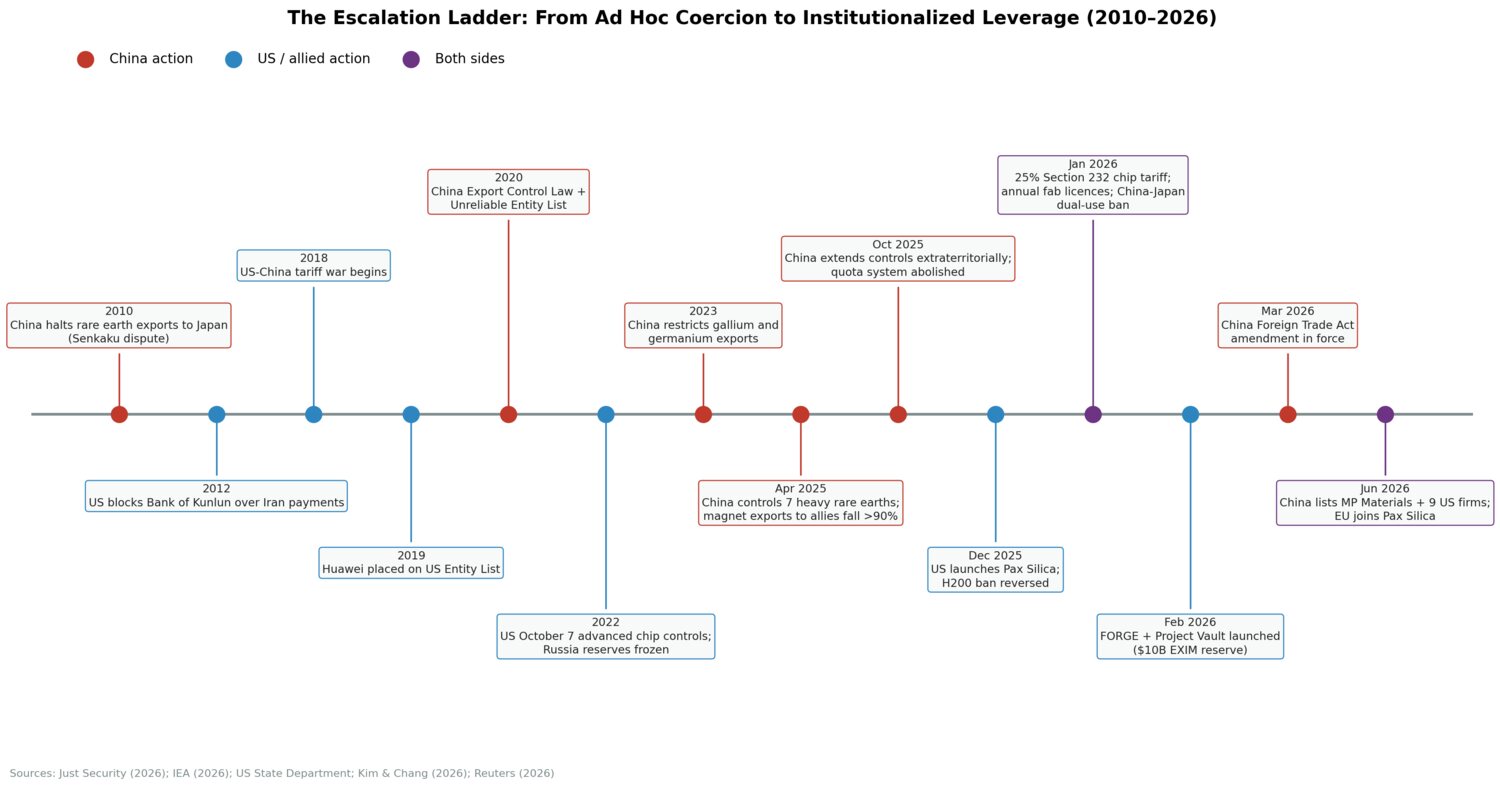
The decisive acceleration came in 2025 and 2026. In April 2025, Beijing placed export controls on seven heavy rare earth elements; magnet shipments to Japan and South Korea collapsed by more than 90 percent within two months.10 In October 2025, China abolished its export quota system entirely, replacing it with a licensing regime that extends extraterritorially to foreign-made products containing Chinese-origin materials.11 In June 2026, Beijing placed ten US defense-linked firms under a full dual-use export ban.12
Three postures now define the landscape. Offensive coercion uses chokepoints to punish and deter. Defensive resilience builds redundancy at home through stockpiles, subsidies, and reshoring. Flexible hedging spreads exposure across blocs, the strategy of India, the Gulf states, and much of the Global South.
| Dimension | Efficiency Economy (1990–2018) | Leverage Economy (2018 onward) |
|---|---|---|
| Guiding logic | Produce cheapest, sell anywhere | Dependencies are weapons |
| Location decisions | Comparative advantage | Chokepoint control and political trust |
| Supply chain design | Single-source, just-in-time | Redundant, politically vetted, trusted-bloc |
| View of interdependence | Stabilizing force | Strategic exposure |
| Trade governance | Multilateral rules (WTO) | Plurilateral coalitions and licensing regimes |
| Cost structure | Structural deflation | Permanent security premium |
| Key corporate metric | Landed cost | Weighted exposure to chokepoints |
Minerals: The Tightening Chokepoint
The most acute vulnerability sits at the base of the physical supply chain. Critical minerals, the inputs to every electric vehicle motor, wind turbine, missile guidance system, and data center, pass through refining stages overwhelmingly concentrated in one country. China leads global refining for 19 of the 20 most critical minerals, with shares reaching 99 percent for gallium, 96 percent for graphite, 95 percent for manganese, and 91 percent for rare earths.4
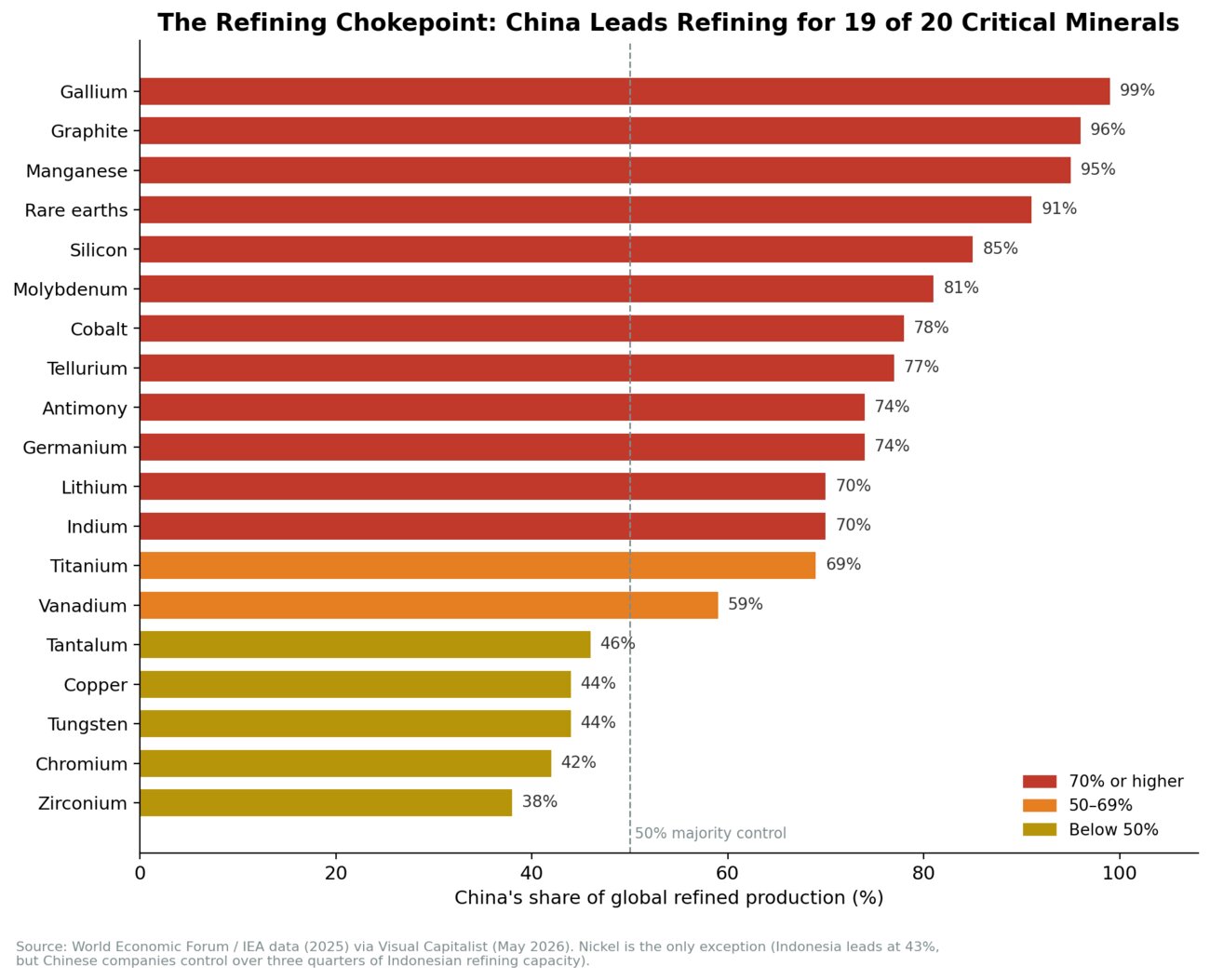
This dominance was not an accident of geology. Rare earth deposits exist on every continent, and China accounts for only about 60 percent of mining. The monopoly was built downstream, through two decades of patient industrial policy and state capital that priced Western competitors out of the separation and refining business. The value chain narrows as it approaches the highest-value stages: 60 percent Chinese share at the mine, 91 percent at the refinery, and 94 percent at the magnet factory.3
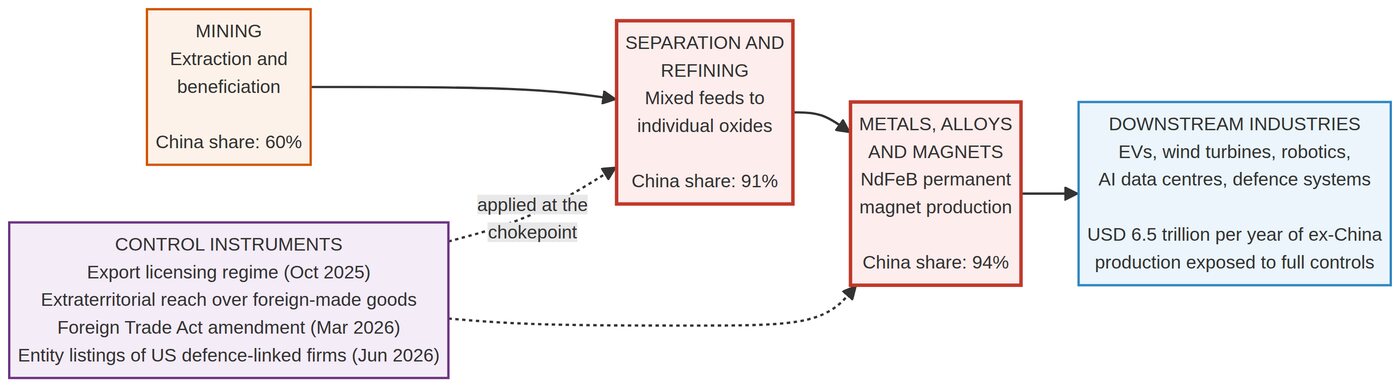
What changed in 2025 and 2026 is not the monopoly itself but Beijing's willingness to use it. The International Energy Agency estimates that full implementation of China's export controls would place approximately 6.5 trillion dollars per year of downstream production outside China at risk, with the United States and Europe each facing more than 1.5 trillion dollars of exposure, and the automotive sector alone accounting for over 3 trillion dollars.3
The controls now function as a dial rather than a switch. The scale of the rebuild task is sobering: on current plans, ex-China capacity by 2035 will cover only about half of non-Chinese mining demand, one quarter of refining demand, and less than one fifth of magnet demand. Closing the gap would require mining capacity to double, refining to quadruple, and magnet production to grow sixfold beyond what is already planned.3
The Swing Powers: India and the Digital Swaraj
In the Leverage Economy, nations that are neither superpowers nor entirely dependent must navigate the crossfire. Their positioning is defined by two axes: alignment with the US or China-led blocs, and sovereign supply chain capability.
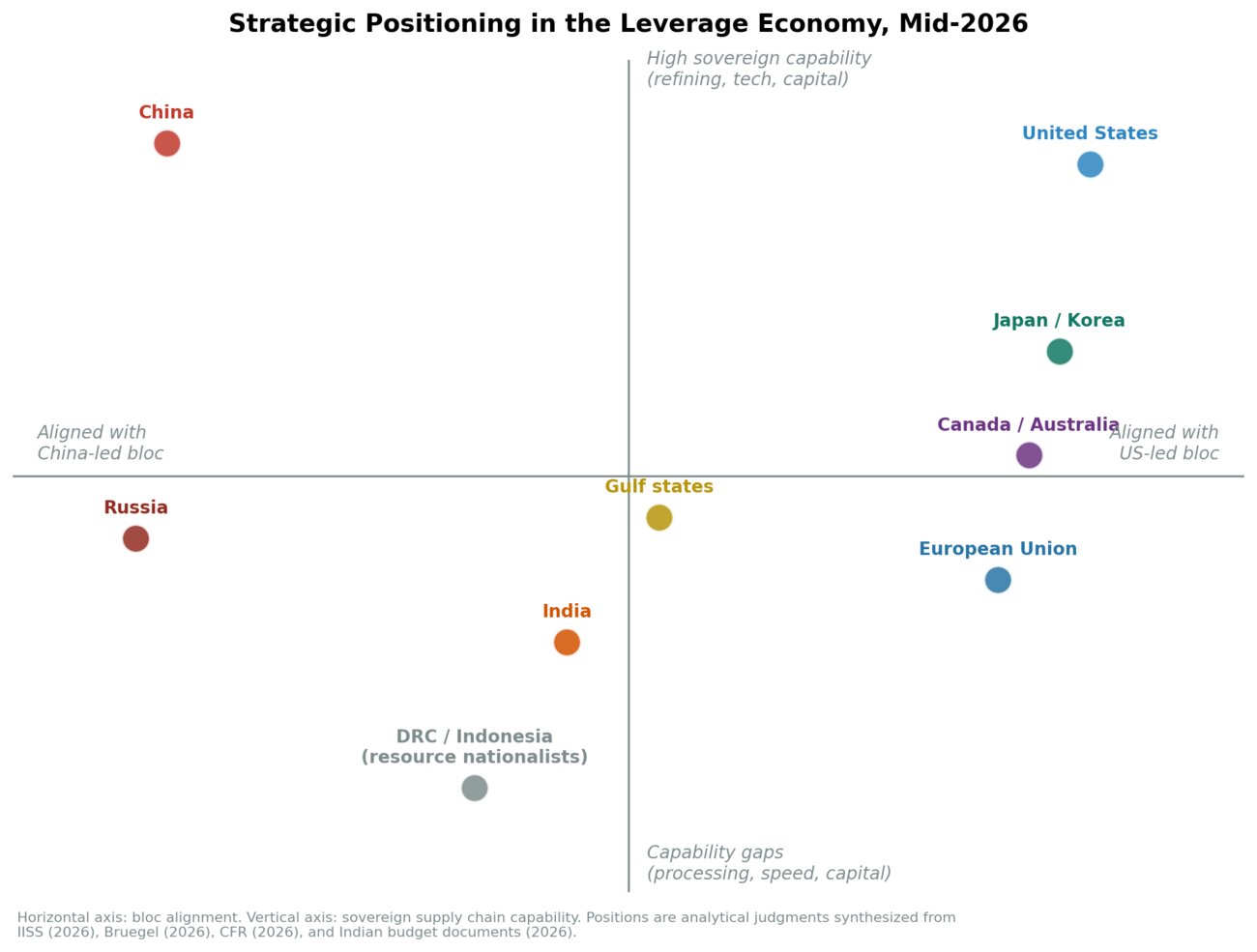
India is the ultimate multi-aligned hedger. It possesses significant capability gaps in processing and capital but is determined to maintain strategic autonomy. In the 2026-27 Union Budget, India allocated over 4 billion dollars to explore 1,200 sites and established a subsidized scheme to build domestic rare earth permanent magnet corridors in four states.20 India is simultaneously partnering with the US-led Minerals Security Partnership, securing lithium rights in Argentina, and deepening ties with Russia and Brazil.
Crucially, India's vulnerability extends beyond physical supply chains. A September 2025 report by the Global Trade Research Initiative highlighted that India's reliance on US software, cloud services, and social media platforms, including over 500 million smartphones running on Android, poses a severe economic and security risk. A sudden US-ordered cutoff could paralyze digital payments, tax filings, and government services. GTRI proposed a Digital Swaraj Mission to achieve self-reliance in operating systems, sovereign cloud hosting, and homegrown cybersecurity by 2030, arguing that "sovereignty will be measured not just by territory or GDP but by who controls the code."2526
China's leverage is not absolute. Its economy remains structurally dependent on imported oil through the vulnerable Strait of Hormuz, copper, and agricultural goods. Its buildout of renewables, electrification of transport, and retention of coal as a strategic backup function as defensive hedges against exactly the kind of pressure it threatens to impose on others.27
The Cost of Resilience
The shift from efficiency to leverage is not free. Re-engineering global supply chains to prioritize security over cost generates a measurable macroeconomic drag. A June 2026 report by the World Economic Forum and Oliver Wyman finds the current policy trajectory already imposes a 213 to 307 billion dollar annual cost on the global economy.9
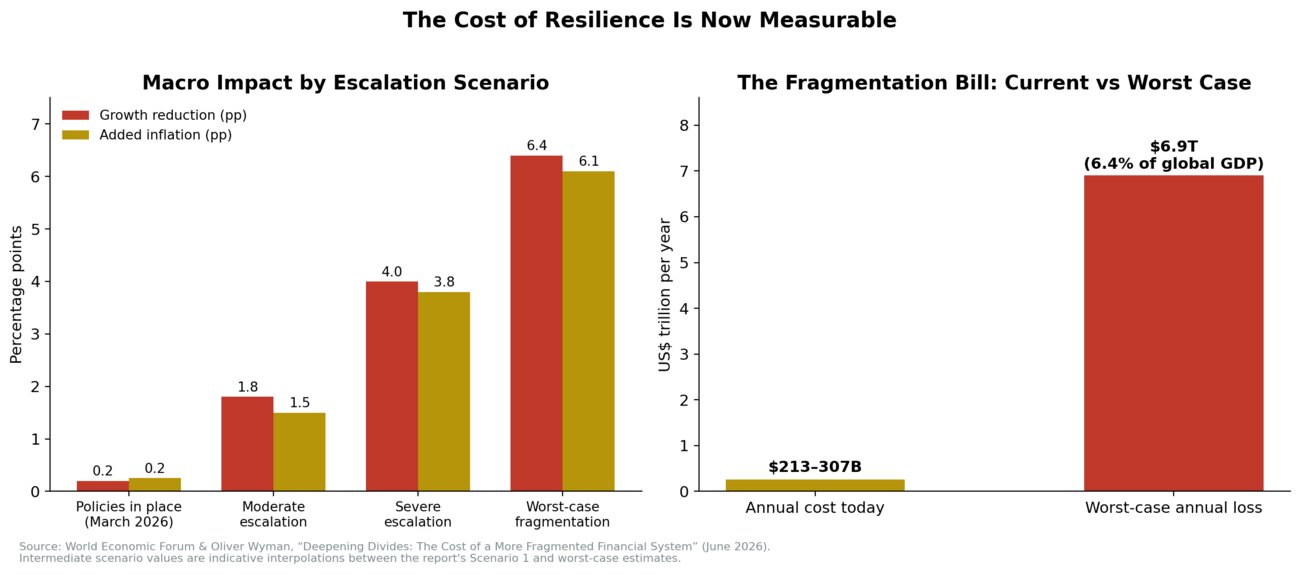
The costs scale dramatically with escalation. In a worst-case scenario, where global trade splits cleanly into two non-interacting blocs, the world would face a 6.4 percentage point reduction in growth and a 6.1 percentage point spike in inflation. That equates to a 6.9 trillion dollar annual loss, larger than the GDP of any nation except the US and China.9 For businesses, the era of structural deflation is over. Supply chain redundancy, friendshoring, and the financing of ex-China processing all contribute to a permanent inflation floor.
The Road to 2030
Three scenarios define the operating environment through 2030.
| Scenario | Description | Business impact |
|---|---|---|
| Managed Bifurcation (base case) | A two-tier system. Advanced technologies and critical minerals are controlled via licensing valves; legacy trade continues. | Permanent regulatory risk premium; dual-sourcing becomes mandatory; moderate inflation floor. |
| Escalatory Fragmentation (downside) | Tit-for-tat retaliation spirals. Broad export bans replace targeted licensing. Trade routes bifurcate cleanly. | Severe supply shocks; stranded assets in hostile jurisdictions; high inflation and lower growth. |
| Sovereign Silos (digital focus) | The conflict expands into software and data. Nations mandate local operating systems, sovereign clouds, and walled-garden AI. | Fractured IT architectures; duplicated software costs; end of borderless digital services. |
The Business Playbook
The Leverage Economy requires a new corporate operating system. Resilience can no longer be a secondary consideration managed by procurement. It is a board-level imperative.
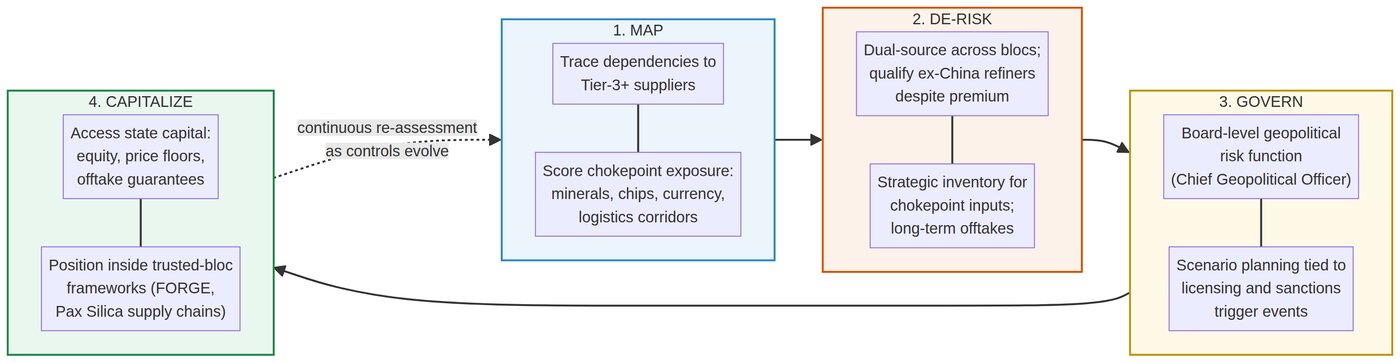
- Map. Trace dependencies down to the Tier-3 and Tier-4 levels, including digital infrastructure, cloud hosting, and operating systems. Quantify the revenue at risk from export controls, tariff spikes, or digital service cutoffs.
- De-Risk. Dual-source across blocs. Qualify ex-China refiners and absorb the price premium as the cost of insurance. Move away from pure just-in-time for chokepoint inputs; secure long-term offtake.
- Govern. Institute a board-level geopolitical risk function. Tie corporate strategy to specific trigger events: revocation of fab licences, expansion of Entity Lists, mandates for sovereign cloud migration.
- Capitalize. Pursue state-backed equity, loans, and price-floor guarantees. Position manufacturing, procurement, and digital infrastructure inside emerging plurilateral frameworks for preferential access.
The AdiOS Lens
We publish this analysis because its last axis is our whole thesis. The Leverage Economy started with minerals and chips. It is now moving into software, data, and AI, exactly the "Sovereign Silos" scenario above. GTRI said it plainly: sovereignty will be measured by who controls the code.
For a bank, a hospital, or a government in a hedging nation like India, that reframes the AI decision. Renting intelligence from a foreign cloud is not just a privacy question or a compliance question. It is a chokepoint you are volunteering to sit under. The operating system, the cloud, and the model become dependencies a distant policy can switch off.
This is the problem AdiOS was built for. A sovereign AI operating system keeps inference, institutional memory, and the intelligence you build inside your boundary. The models stay interchangeable utilities; the intelligence that compounds stays yours. In an economy where dependencies are weapons, the durable move is to own the layer that cannot be licensed away from you.
Conclusion
The Leverage Economy is not a temporary disruption. It is a structural reality. The weaponization of interdependence has altered the calculus of global trade. From rare earth refineries and semiconductor fabs to cloud servers and payment networks, the battle lines are drawn.
Those who cling to the old operating system will find themselves exposed to sudden, devastating shocks. Those who adapt, by mapping vulnerabilities, de-risking physical and digital supply chains, governing for geopolitics, and capitalizing on state-led industrial policy, will build the resilient enterprises required to thrive in a fragmented world.
References
- Farrell, H., & Newman, A. L. (2019). Weaponized Interdependence: How Global Economic Networks Shape State Coercion. International Security, 44(1).
- Just Security (2026). The Evolution of US-China Economic Statecraft.
- International Energy Agency (2026). Rare Earth Elements: Executive Summary.
- Visual Capitalist (2026). Charted: China's Grip on Critical Mineral Refining. Data from WEF and IEA.
- IISS (2026). US Critical Minerals Diplomacy: From America First Deals to Pax Silica.
- CFR (2026). U.S., Allies Aim to Break China's Critical Minerals Dominance.
- Semiconductors Insight (2026). US China Chip Export Controls H200 2026: The Policy Zigzag.
- CEPR / Goldberg, L. & Hannaoui, O. (2026). The Slow Erosion of Dollar Centrality. Data from IMF COFER and the Federal Reserve.
- World Economic Forum & Oliver Wyman (2026). Deepening Divides: The Cost of a More Fragmented Financial System.
- Reuters (2026). China targets US rare earth and other firms with export controls.
- Kim & Chang (2026). Strengthening of Export Control of Rare Earths.
- S&P Global (2026). Rare earth supply bottlenecks set to persist in 2026.
- World Economic Forum (2026). Is global trade and financial fragmentation here to stay?
- Bruegel (2026). Competing Inputs: How the EU can improve critical raw materials supply security.
- Jones Day (2026). The EU Critical Raw Materials Act and Its Impact on the Mining Sector.
- Rice IAS (2026). India's Critical Minerals Strategy: From Policy Shift to Strategic Mainstream (Union Budget 2026-27).
- Economic Times / GTRI (2025). India should develop its own sovereign digital solutions.
- Economic Times / GTRI (2025). India's reliance on US software, cloud services, social media platforms poses economic vulnerability.
- Mayer, T., et al. (2026). The Fragmentation Paradox: De-risking Trade and Global Disputes. Yale University.
An AdiOS Platform analysis, Hyderabad. This piece synthesizes public reporting from the sources cited above; the figures and claims are attributed to them. The AdiOS Lens section is our own commentary.